
Putnam County
Commercial snow and masonry in Carmel, the county seat
Carmel is where Putnam County's business gets done. The County Office Building, the Justice Center and the 1814 courthouse all sit along Gleneida Avenue, with the retail strip on Route 52 running past them and Lake Gleneida on the other side of the road. It is the densest concentration of buildings in the county that cannot simply close when it snows.
That gives the town a different centre of gravity from the rest of our service area. In Mahopac the work is residential and it is about grade. Here a large share of it is commercial, seasonal, and written into a contract before the first forecast — because a property that opens to the public at eight in the morning needs its lot and its walks done by seven, not queued behind six driveways.
- Lake Gleneida
- Gleneida Avenue
- Route 52
- Putnam County Office Building
- Lake Gilead
- Fahnestock State Park
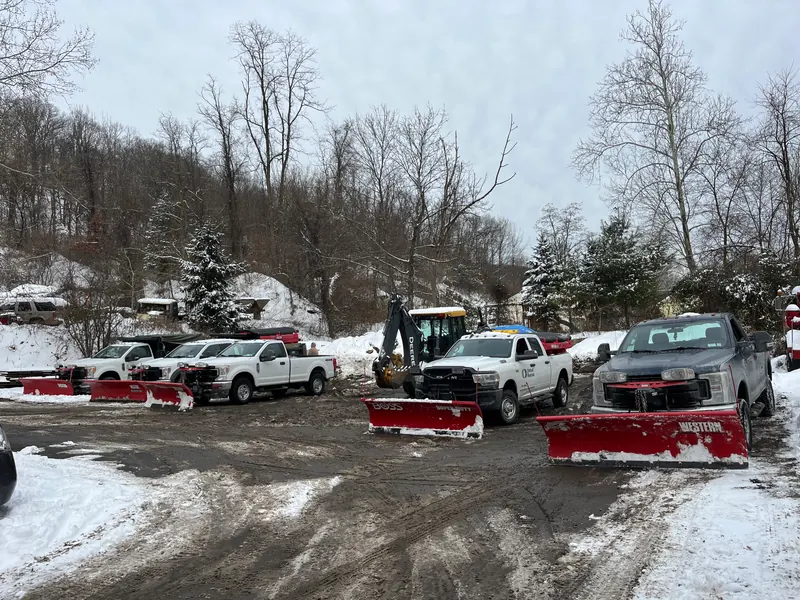
Plow fleet staged in the yard before a storm
Building in the county seat
Carmel hamlet wraps around Lake Gleneida, and the town beyond it holds Lake Gilead, part of the Croton Falls Reservoir and the majority of the West Branch Reservoir — three of the Croton system's waters inside one town's borders, on the town's own account. Fahnestock State Park sits just north. It is a place defined by protected water and public land, and that shapes what can be built where far more than the soil does.
The building stock reflects the town's role rather than a single era: municipal and commercial construction along the Gleneida Avenue and Route 52 spine, and residential behind it.
For commercial work the constraint is rarely geological. It is access, hours, and the fact that a parking lot has to be usable at a specific time — which is a scheduling problem, not an excavation one.
What we mostly do in Carmel
Commercial snow and ice management leads here, and it is work owner Joe Galeno runs himself. Property managers, HOAs, retail centres and municipal-adjacent buildings on seasonal contracts, with trucks assigned to a route before the season starts rather than dispatched when the forecast changes.
Ice control matters more than plowing on properties like these, because ice is what generates claims. Pre-treating before a storm stops a bond forming between the pack and the pavement, and every application is recorded — what went down, where, and when. In a slip-and-fall, that record is the defence.
The construction side follows the same pattern: concrete walks, curbing, ADA-compliant entry paths and lot repairs, scheduled around a building that stays open while we work.
Permits and thresholds in the Town of Carmel
Carmel's Building Department publishes more of its requirements than most towns around here, which makes quoting more predictable. Retaining walls over four feet have to be shown on the plot plan with details, and walls over six feet must be certified by a New York State licensed structural engineer. Patios need a permit unless they sit under twelve inches in height.
Driveway grades are specified in three parts rather than one, and this is the detail most often got wrong. The first fifteen feet in from the road may not exceed 6%. The thirty feet out from the garage slab may not exceed 7%. The profile between those two may not exceed 15%. And any driveway exceeding 7% at any point has to be paved in its entirety. A drive designed to a flat 15% gets turned back at the road end.
The stormwater thresholds are the tight ones, and the reason is the watershed. A land disturbance of 5,000 square feet or more requires coverage under the state's construction general permit; between 5,000 square feet and an acre that means a plan covering erosion and sediment control, and above an acre a full plan including permanent stormwater features. In most of New York the trigger is an acre — 43,560 square feet — so this is roughly nine times tighter.
Fees are published, and the schedule is worth reading rather than summarising: a building permit runs $125 plus $15 per $1,000 of estimated construction cost, and a certificate of occupancy is $80 residential or $150 commercial. A driveway permit including two inspections is priced separately and carries a refundable bond. We handle the filing, and we itemise those fees on the estimate rather than folding them into a rate — the schedule is public, so anything we charge for is checkable against it.
Where these figures come from
- Town of Carmel — Building Department
- Town of Carmel — combined IPP and SWPPP requirements
- Town of Carmel — fees
- Town of Carmel — The Croton Watershed
- Town of Carmel — 2026 adopted user fees
Codes and thresholds change. We confirm what applies to your parcel as part of quoting rather than relying on what was true when this page was written.
Questions we get in Carmel
How does a seasonal snow contract work?
We walk the property before the season, agree the plowing trigger depth — usually two inches — map the route, and decide where snow gets stacked so it is not sitting on the drainage or in the spaces you need in the morning. Then the property is assigned to a truck for the season. We quote both per-event and full-season pricing and will tell you honestly which suits the property; a seasonal contract fixes the cost of a winter nobody can forecast, which is usually the trade a budget wants to make.
Do you salt before a storm or after it?
Before, where the forecast allows it. Salt applied ahead of a storm stops ice bonding to the pavement, and it takes appreciably less material to prevent that bond than to break it afterwards. We still treat during and after — pre-treating is not a substitute for the rest of the work, it is what makes the rest of it effective.
What size project triggers a stormwater plan in Carmel?
5,000 square feet of land disturbance. Across most of the state the threshold is one acre — 43,560 square feet — so Carmel's is roughly nine times tighter, and the reason is that the town sits in New York City's water-supply watershed. A large patio, a long driveway and the excavation and staging around them reach 5,000 square feet more easily than people expect, so it is worth establishing at the estimate rather than discovering mid-job.
Can you work on a building that has to stay open?
That is most of what we do here. Concrete and paving work on an occupied commercial property gets phased so that entrances, accessible routes and fire exits stay usable throughout, and the sequence goes on the schedule before anything is dug up.
We also work in
Working on something in Carmel?
Tell us what you are trying to do and we will come and look at it. Free written estimates, no obligation — call 845-470-6093.