
Putnam County
Masonry & landscaping around Lake Mahopac
Mahopac is built around a lake, and that single fact decides most of the outdoor construction that happens here. The lots that ring Lake Mahopac fall away toward the water — sometimes gently, often not — so the usable part of a property is frequently the part somebody built a wall to create. Nearly every project we quote on the lake side of town is a grade problem before it is anything else.
It is also the part of Putnam County where the rules follow the water. Kirk Lake, just west of and well below Lake Mahopac, is one of only three controlled lakes in New York City's Croton water-supply system. That puts properties near it inside a regulatory boundary most homeowners have never heard of and every contractor working here should have.
- Lake Mahopac
- Kirk Lake
- US Route 6
- Route 52
- North Lake Boulevard
- Secor Road
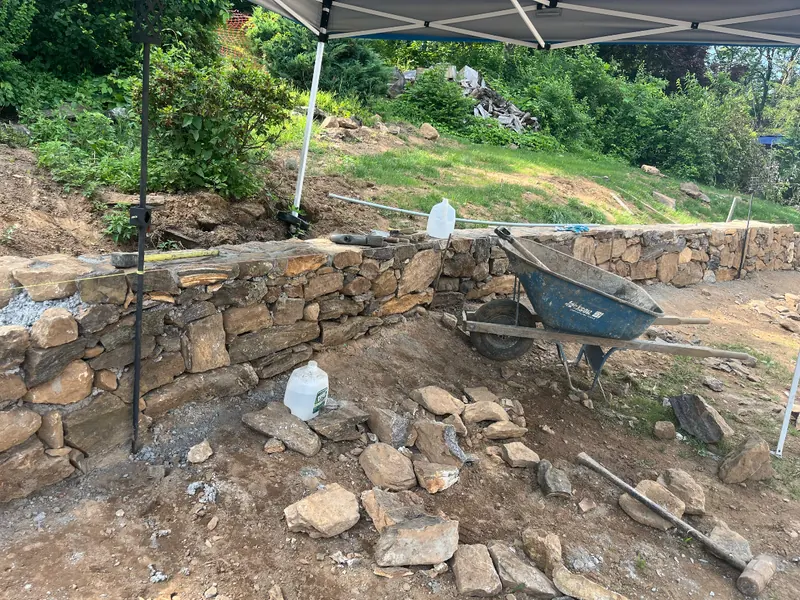
Dry-laid fieldstone wall, second lift
What the ground does on a Mahopac lot
About a sixth of the hamlet's area is open water — 1.2 of its 7.3 square miles, on the Census figures — and the ground around it falls toward the lake. The characteristic Mahopac property is one with a real fall across it, which is why so much of the masonry here is retaining rather than paving.
Under it is glacial till: the compacted, stony mix the ice sheet left behind, and the parent material of the soils mapped through this part of the Hudson Valley. Two things follow. The first is stone — till carries boulders, and finding one in a wall trench is a normal day rather than an emergency. The second is drainage: the dense layer within till does not let water pass easily, so on the lower half of a sloping lot water arrives from uphill and then has nowhere to go. A wall built into that without a drainage path behind it is holding back saturated soil, and saturated soil pushes roughly twice as hard as drained soil does — that is a standard earth-pressure calculation, not a figure of speech.
So on a lake-slope property the sequence is not negotiable. Intercept the water uphill, drain behind the wall to daylight, then build. Skipping the first two produces a wall that looks correct for about four winters.
Where most Mahopac projects start
Retaining walls, first and by a distance. Terracing a slope into two or three usable levels is the standard answer to a lakefront lot, and a terraced wall system is a structure — footings below frost, drainage stone and pipe behind every lift, geogrid where the height needs it.
Then drainage, which on this side of town is usually a surface-water problem rather than a groundwater one: rain running downhill across the property toward the house and then toward the lake. Intercepting it uphill costs a fraction of what treating the symptom at the foundation does.
Patios come third and benefit from the first two. A terrace built on ground that has been drained and held stays flat; the same terrace built first has to be lifted when the wall behind it is fixed.
The watershed rules, and where they bite in Mahopac
Mahopac sits in the Town of Carmel, which holds part of the Croton Falls Reservoir, most of the West Branch Reservoir, and two of the Croton system's three controlled lakes — with Kirk Lake making a third body of regulated water inside the hamlet itself. Properties near any of them fall under New York City's Watershed Rules and Regulations.
The section that matters for this work is §18-39, and it is worth stating carefully because it is stricter than it sounds and narrower than it sounds. It prohibits new impervious surface within 100 feet of a watercourse or wetland, and within 300 feet of a reservoir, reservoir stem or controlled lake. But §18-39(a)(2) then exempts non-commercial ancillary improvements and additions to an individual residence from that prohibition, and the definition of impervious surface in §18-16 excludes crushed stone and gravel. So a patio at the back of a house is very often outside it. Whether yours is depends on the parcel, and it is checked rather than assumed.
Driveways carry their own rule and it turns on a date. A driveway serving a residence approved before 1 March 2010 is exempt from the prohibition entirely. Where approvals came on or after that date, a driveway within 100 feet of a perennial stream — or 50 feet of an intermittent stream or wetland — needs an Individual Residential Stormwater Permit from NYC DEP on top of anything the town asks for. Most houses in Mahopac predate 2010; new build and substantial reconstruction do not.
The Town of Carmel adds its own layer. Any land disturbance of 5,000 square feet or more requires coverage under the state's construction stormwater permit and a stormwater pollution prevention plan. In most of New York that trigger is one acre — 43,560 square feet — so the watershed tightens it by a factor of roughly nine. Carmel also requires that retaining walls over six feet be certified by a New York State licensed structural engineer, and shows walls over four feet on the plot plan.
None of this is a reason not to build. It is a reason to know before the estimate is written rather than after the excavator is on site, and it is why we check the boundary and the town rules as part of quoting rather than as a surprise later.
Where these figures come from
- NYC Watershed Rules and Regulations (Title 15 RCNY Ch. 18)
- Town of Carmel — The Croton Watershed
- Town of Carmel — combined IPP and SWPPP requirements
- NYC water supply — Croton system reservoirs and controlled lakes
- Town of Carmel Building Department — address and permit requirements
- US Census Gazetteer — Mahopac CDP land and water area
Codes and thresholds change. We confirm what applies to your parcel as part of quoting rather than relying on what was true when this page was written.
Questions we get in Mahopac
Do I need a permit for a retaining wall in Mahopac?
Mahopac is unincorporated, so permits go through the Town of Carmel Building Department at 60 McAlpin Avenue, Mahopac. Two published thresholds matter. Retaining walls over four feet have to be shown on the plot plan with details; walls over six feet must additionally be certified by a New York State licensed structural engineer. Whether a wall below four feet needs a building permit at all is worth a call to the department rather than taken off a contractor's website — and we handle the filing either way.
My property runs down to the lake. Can I still build a patio near the water?
Usually yes, and the reason is an exemption people rarely hear about. NYC's Watershed Rules do prohibit new impervious surface within 100 feet of a watercourse or wetland and within 300 feet of a reservoir, reservoir stem or controlled lake — but the same section exempts non-commercial ancillary improvements and additions to an individual residence, and the definition of impervious surface excludes crushed stone and gravel. Lake Mahopac and Kirk Lake are also different cases, and the setback that applies depends on which water you are near and where the mapped boundary runs. We check the parcel and the exemption before quoting rather than after.
Why do so many walls around the lake lean?
Almost always drainage. Saturated soil pushes about twice as hard on a wall as drained soil does — run the standard earth-pressure numbers and it comes out a shade over two — and the dense layer in glacial till holds water rather than shedding it. A wall built without clean stone and a perforated pipe behind it is carrying roughly double its design load every time it rains. It usually takes three or four winters to show.
We keep hitting rock. Does that change the price?
It can, and we will say so before it does. Glacial till carries boulders, and Putnam County has plenty of shallow ledge. A day of excavation can become three when a wall trench runs into rock that needs breaking. It is the single most common reason a job here takes longer than the first estimate, which is why we flag it as a risk at the estimate rather than as a change order.
We also work in
Working on something in Mahopac?
Tell us what you are trying to do and we will come and look at it. Free written estimates, no obligation — call 845-470-6093.