
Westchester County
Yorktown masonry, where the rock comes up to meet you
Yorktown is the town where the excavator earns its money. The till here formed from granite, schist and gneiss, and on the ridges and hilltops the soil over that rock runs thin — the town's own forestry plan for Turkey Mountain, which tops out at 831 feet, records many rock outcroppings and maps soil complexes that carry rock outcrop in their names.
That reorders a job whenever it turns up. On a lot with three feet of soil over till, a wall trench is a day of digging. Where rock is close to grade, the same trench needs a hammer on the excavator and it is three days. Depth to rock varies enough from one Yorktown lot to the next — and across a single lot — that excavation carries real price variance here, and the honest thing is to say so at the estimate rather than discover it in week two.
- Turkey Mountain
- New Croton Reservoir
- Pines Bridge
- Jefferson Valley
- Mohegan Lake
- Shrub Oak
- North County Trailway
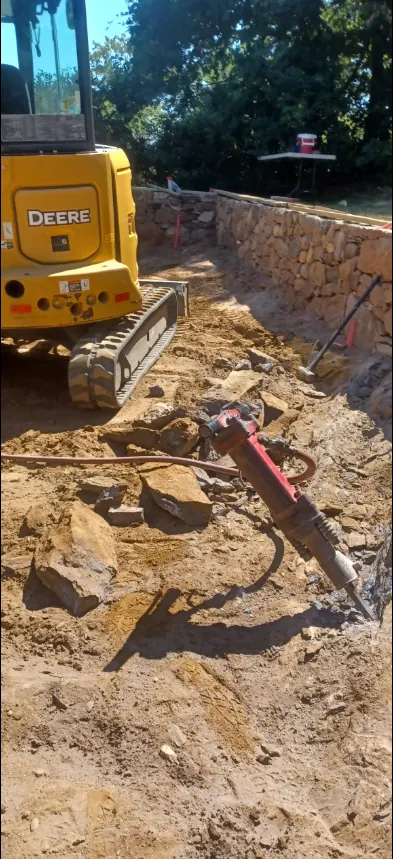
Breaking ledge behind a new wall line
Rock, and what it costs
Yorktown covers about forty square miles of rolling hills across five hamlets — Yorktown Heights, Crompond, Jefferson Valley, Mohegan Lake and Shrub Oak. Lots are generally larger here than in the Putnam hamlets, and much of the housing stock is post-war.
What the ground does to a job here is mostly about rock, and where it is. Soils mapped across the town's ridges and hilltops include rock-outcrop complexes; soils in the valleys between them are described as very deep. So depth to rock is not a townwide constant, it is a per-lot question — and that is the practical point. In practice it means three things. Footings sometimes cannot go where the plan wants them and get relocated, or pinned to the rock instead. Drainage cannot always be solved by infiltration, because water will not soak into stone — it has to be routed somewhere instead. And excavation prices carry variance, because nobody knows what is eighteen inches down until something opens the ground.
The upside of rock is that once you are on it, you are on it. A wall footed on rock is not going anywhere, and the fieldstone that comes out of a Yorktown excavation frequently goes back into the wall it came out of.
The work that suits Yorktown ground
Walls, because the terrain produces them and because rock is a good thing to build on once you have reached it. Natural stone walls in particular suit this town — the material is local, it matches what is already visible on the property, and a dry-laid wall drains through its own face rather than needing the full envelope a solid segmental wall does.
Driveways, because Yorktown lots are long and many of them climb. A driveway on a Yorktown grade is a drainage design as much as a paving job: where the water leaves matters more than what the surface is made of, and a drive that pitches toward a garage gets solved with a trench drain and a regrade before any surface goes down.
And excavation-heavy work generally. Rock removal, foundation and frost-wall footings, sites where somebody else has already quoted and then discovered what is under the grass.
Yorktown's retaining wall threshold — the clearest of the four
Yorktown publishes the number that most towns leave you to phone about. Under the town's building construction code, a retaining wall lower than 4.5 feet is exempt from needing a building permit — unless it supports a surcharge, meaning a load above it such as a driveway or a structure, or impounds certain liquids. At 4.5 feet and above, a permit is required.
That is worth knowing before you design, because a wall at 4 feet 8 inches and a wall at 4 feet 4 inches are two different projects on paper even though they look the same in a garden. Where a design lands near the line we will tell you, and where stepping it into two shorter walls serves you better, we will say that too.
Yorktown also has its own stormwater and erosion-control chapter in the town code, separate from anything New York City requires, and part of the town lies inside the Croton watershed. Which side of the mapped watershed line a given parcel sits on is a parcel-level question, and it gets checked rather than assumed.
Permits go through the town at 363 Underhill Avenue, Yorktown Heights. The department announced an online permit system in September 2025 with full services expected the following January; whether it is fully live when you read this is worth a call rather than an assumption.
Where these figures come from
- Town of Yorktown Code — Building Construction Administration (retaining wall exemption)
- Town of Yorktown Code — Stormwater Management and Erosion and Sediment Control
- Turkey Mountain Watershed Forestry Plan (Town of Yorktown) — soils, outcrop and elevation
- Town of Yorktown — Building Department, 363 Underhill Avenue
- US Census Gazetteer — Town of Yorktown land and water area
Codes and thresholds change. We confirm what applies to your parcel as part of quoting rather than relying on what was true when this page was written.
Questions we get in Yorktown
How tall can a retaining wall be in Yorktown before I need a permit?
4.5 feet. Yorktown's code exempts retaining walls lower than that, and requires a permit at that height and above. The exemption does not apply if the wall supports a surcharge — a driveway, a parking area or a structure bearing on the ground above it — in which case a permit is required regardless of height.
You hit rock on my job. What happens to the price?
It is flagged as a risk in the estimate before work starts, because in Yorktown it is common enough to plan for. Where rock is found, we stop, show you what we have found, and price the removal before continuing. What we will not do is absorb three days of hammering silently and then present it at the end.
Can I put in a dry well to fix a wet yard here?
Sometimes, and often not. A dry well works by letting water soak away, which needs soil that will take it and depth to put it in. On a lot where rock is close to the surface there may be neither, and a dry well that cannot drain becomes a buried tank that stays full. We dig a test pit before recommending one, and where infiltration will not work the answer is to route the water somewhere instead.
Do you work in Jefferson Valley and Mohegan Lake?
Yes — those and Shrub Oak, Crompond and Yorktown Heights. They are hamlets of the same town, so the permits and the code are identical across all of them; the ground varies more than the paperwork does.
We also work in
Working on something in Yorktown?
Tell us what you are trying to do and we will come and look at it. Free written estimates, no obligation — call 845-470-6093.