
Masonry & Hardscaping
Concrete with its joints where somebody put them
Slabs, footings, sidewalks, curbing and steps — poured on a prepared base, reinforced, and jointed where it will crack anyway.
The problem
You need concrete that will not crack apart in five years — a slab, a sidewalk, curbing, steps, or the footings something else is going to sit on.
Concrete cracks. That is not a defect, it is what concrete does as it cures and as it moves with temperature; the only question is whether it cracks where someone decided or wherever it likes. Control joints cut to roughly a quarter of the slab's depth, at spacings of about twenty-four to thirty times that depth, give it a designed place to do it. A slab poured without them will still crack, just diagonally across the middle.
The other two things that decide whether a pour lasts here are the base and the air. Concrete needs a compacted, well-drained base for the same reason a patio does — a slab bridging a soft spot will break over it. And in a freeze-thaw climate it needs air entrainment: microscopic bubbles that give freezing water somewhere to expand into instead of spalling the surface off. Every exterior pour on this site is air-entrained, and de-icing salt on a non-entrained slab is how a two-year-old sidewalk ends up looking forty.
Footings go below the frost line. The residential code requires that depth to come from the frost line specified in Table R301.2(1), and that table is filled in by each jurisdiction rather than set once for the state — which is why 42 inches is the working figure across this part of the Hudson Valley, and why we confirm it with the building department for the town rather than treating it as a constant.
What the work includes
- Concrete driveways and aprons
- Slabs, pads and equipment bases
- Sidewalks and municipal-spec walkways
- Curbing and Belgian block setting beds
- Poured steps and landings
- Footings and frost walls
- Demolition and removal of failed concrete
What you end up with
A pour with its joints where they belong, its surface intact through a winter of salt, and a base under it that will not settle.
How long it takes
Prep and pour on a residential slab or walk is two to four days. Then cure: foot traffic at 24–48 hours, vehicles at seven days. The cure is not a scheduling suggestion — loading green concrete is how you get cracks in week one.
Concrete Services we've built
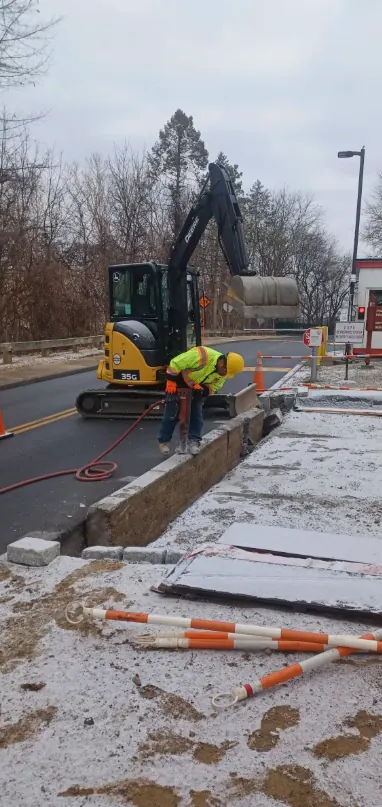
Photographs from our own jobs.
Where we do concrete services
Across Putnam and northern Westchester County. The ground is not the same in all four of these towns and it changes how this work gets built — each page says what changes there.
Usually goes with
These three come up on the same properties often enough that it is worth pricing them together rather than twice.
Get a concrete services estimate
Tell us what you are trying to do and we will come and look at it. Free written estimates, no obligation.